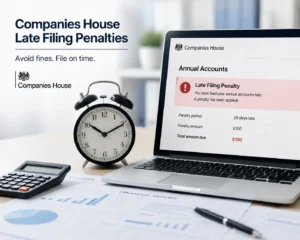

If you file your company accounts late, Companies House late filing penalties apply automatically. There is no general grace period before a penalty is charged. For a private company or LLP, the penalty starts at £150 when the accounts are up to one month late. The penalty increases as the delay gets longer.
If the accounts are more than one month but no more than three months late, the penalty is £375. If they are more than three months but no more than six months late, it is £750. When the accounts are more than six months late, the penalty is £1,500. For public companies, the penalties are higher. They range from £750 to £7,500, depending on how late the accounts are filed.
Companies House Late Filing Penalty Fees
The late filing penalty only applies to accounts. The level of the late filing penalty depends on how late the accounts reach Companies House.
Length of period (measured from the date the accounts are due) | Late filing penalty for a private company or LLP | Late filing penalty for a public company |
Not more than 1 month | £150 | £750 |
More than 1 month but not more than 3 months | £375 | £1,500 |
More than 3 months but not more than 6 months | £750 | £3,000 |
More than 6 months | £1,500 | £7,500 |
Who Pays the Late Filing Penalty?
The late filing penalty is charged to the company, but directors remain responsible for making sure the company meets its Companies House filing obligations. Using an accountant or company secretarial service does not remove the directors’ responsibility.
- Directors must ensure accounts are filed on time
- Late filing penalties reduce company funds
- Repeated late filings can increase compliance risks
- Serious non-compliance may lead to further action
- Professional support can help prevent missed deadlines
Our professional company secretarial services help you to stay on top of Companies House filing requirements, maintain accurate company records and manage important compliance deadlines. Our team provides practical support to help reduce the risk of missed filings and keep your company records organised and up to date.
What Counts as “Late” With Companies House
Your company accounts are considered late if Companies House receives them after your filing deadline. It does not matter when you post or upload the accounts. If they reach Companies House even one day late, Companies House late filing penalties can apply.
This rule applies to every company on the UK register, whether it is trading, dormant, making a loss, or has never sent an invoice. Companies House does not base the penalty on your turnover or business activity. The key factor is whether your accounts were received by the required deadline.
How Your Filing Deadline Is Actually Worked Out?
Your Companies House filing deadline depends on your company type and whether you are filing your first accounts or subsequent accounts. Knowing which rule applies can help you calculate the correct deadline and avoid a late filing penalty.
Companies House Filing Deadline Rules
Account Type | Company Type | Deadline | How It Works |
Subsequent Accounts | Private companies & LLPs | 9 months | Due 9 months after the end of the accounting reference period |
Subsequent Accounts | Public companies | 6 months | Due 6 months after the end of the accounting reference period |
First Accounts | Private companies & LLPs | 21 months / 3 months | Due on the later of 21 months after incorporation or 3 months after the accounting reference date |
First Accounts | Public companies | 18 months / 3 months | Due on the later of 18 months after incorporation or 3 months after the accounting reference date |
For Example:
A private company has an accounting reference date of 30 September 2025. Its subsequent annual accounts are normally due 9 months after the end of the accounting reference period, making the filing deadline 30 June 2026.
If Companies House receives the acceptable accounts on 15 July 2026, they are late. As the accounts are no more than one month late, the company would receive a £150 late filing penalty.
Filed Late Again? Your Penalty Could Double
If your accounts are late in two consecutive financial years, Companies House automatically doubles the penalty for the second offence. A company that was two months late previous year and paid £375 would owe £750 for the same lateness this year, purely because it happened twice in a row. This is the part that catches growing businesses out. One late filing is often a one-off admin slip. Two in a row starts to look like a pattern, and Companies House treats it that way through the doubled fine.
Not sure when your company accounts are due? Legend Fusions can help you understand your filing deadlines and keep your accounts up to date with Companies House. Our support can help you avoid missed deadlines and the penalties that come with late filing.
Contact Legend Fusions today for reliable company accounts support.
Companies House or HMRC: Which Penalty Applies?
This is an area where many directors get confused, so it is important to understand the difference. A Companies House late filing penalty applies when your statutory accounts are filed late on the public register. It is separate from your Corporation Tax Return and does not replace your tax filing obligations.
HMRC has its own penalty system for late Company Tax Returns. If you miss the deadline, an automatic £100 penalty applies. A further £100 penalty can apply if the return is still outstanding after three months. Additional penalties may apply if the return remains late for six or twelve months, based on a percentage of the tax due. Interest can also be charged on Corporation Tax that is paid late.
The table below highlights the key differences between them.
Difference | Companies House Penalty | HMRC Penalty |
Applies to | Late filing of annual company accounts | Late filing of Company Tax Return |
Issued by | Companies House | HMRC |
Main requirement | Submit statutory accounts on time | Submit Corporation Tax Return and pay tax due |
Initial penalty | Starts from £150 for private companies | Starts with a £100 late filing penalty |
Purpose | Maintains company filing compliance and public records | Ensures companies meet tax reporting obligations |
Important point | Filing accounts does not complete your HMRC tax obligations | Tax return filing does not replace Companies House accounts filing |
It means that missing a deadline can result in separate penalties from Companies House and HMRC. Filing your company accounts with Companies House does not mean that your Company Tax Return has also been filed with HMRC. These are two separate requirements and both deadlines need to be met.
Can You Appeal a Late Filing Penalty?
Yes, Companies House does allow you to appeal a late filing penalty, but the requirements are strict. Your appeal is more likely to be considered when something serious and unexpected happened close to the filing deadline and was outside your control. Examples include a fire or flood that destroyed important records or a sudden, serious illness affecting the person responsible for filing the accounts.
An appeal is unlikely to succeed if the reason for filing late is:
- The company was dormant.
- Your accountant made a mistake or someone you relied on failed to file the accounts.
- You could not afford to pay the penalty.
- You did not know about the filing deadline or understand the filing process.
- The accounts were delayed or lost in the post.
- The directors were travelling or living overseas.
When we submit an appeal on your behalf, we prepare the required information and supporting evidence for Companies House. While the appeal is being reviewed, Companies House will suspend recovery action on the penalty. If the appeal is rejected, we can help you understand the next steps and prepare further supporting information for consideration by the Senior Casework Unit or, where appropriate, the Independent Adjudicators. Our team helps you present your case clearly and ensure the relevant evidence is included at each stage.
Speak to Our Company Secretarial Team Today
What Happens If You Simply Ignore the Penalty?
Paying late is a cost. Ignoring it entirely is a much bigger problem, and the consequences stack on top of each other rather than replacing one another.
- The debt does not go away. Unpaid penalties can be passed to debt collection agencies, and Companies House can pursue payment through the courts.
- Filing late is a criminal offence, separate from the automatic financial penalty. Directors and designated LLP members can be prosecuted personally and fined in a criminal court for persistent failure to file.
- Companies House can start strike-off proceedings against a company that keeps failing to file accounts or its confirmation statement. Once a company is struck off, its bank accounts are typically frozen, and any remaining assets can pass to the Crown.
- Restoring a struck-off company does not wipe the slate clean. Penalties that were outstanding before dissolution still have to be paid, and new penalties can apply to accounts filed once the company is restored.
None of this happens overnight, but each stage is a direct, well-documented consequence of leaving a late filing unresolved rather than dealing with it.
Already Filed Late? Here Is What to Do Next
If you have already filed your company accounts late, the most important thing is to deal with the situation quickly and prevent further problems.
- Check the penalty notice carefully. Confirm the exact number of days late and the amount charged. It will help you understand which penalty band applies to your company.
- Pay the penalty or set up a payment plan promptly. Do not ignore the penalty notice. If the amount remains unpaid, Companies House may take further steps to recover the money.
- Gather evidence only if you have a genuine, exceptional reason to appeal. If something serious and outside your control caused the delay, keep any documents or other evidence that support your appeal. Ordinary reasons, such as an accountant’s delay or poor record-keeping, are unlikely to be accepted.
- File anything still outstanding immediately. If accounts or a confirmation statement are still missing, get them submitted now rather than waiting, since strike-off risk grows with every additional missed deadline.
- Separate your confirmation statement from your accounts. Your confirmation statement and company accounts have different filing requirements and deadlines. Filing one does not mean the other has been completed.
- Put a system in place for next year. A shared compliance calendar or a filing service closes the gap that caused the problem in the first place, and it protects you from the doubled penalty if this happens again.
How Legend Fusions Can Help?
Filing late once is a fixable mistake. Filing late twice is an expensive pattern, and it is one our FCCA-led team helps clients avoid every year. We prepare and file statutory accounts well ahead of your deadline, correct and resubmit any accounts Companies House has rejected, and build a compliance calendar around your specific accounting reference date so nothing is left to the final week.
If you are dealing with a penalty right now, we can also review whether a genuine case for appeal exists, and get any outstanding filings submitted immediately to stop the position getting worse.